

Heavyweight 120 gsm roll
Our heavyweight 120 gsm roll is suited to transfer work where ink volume is high and image density matters. It gives a steadier sheet through the printer path and helps hold detail in dark fills, large solids and rich colour work.
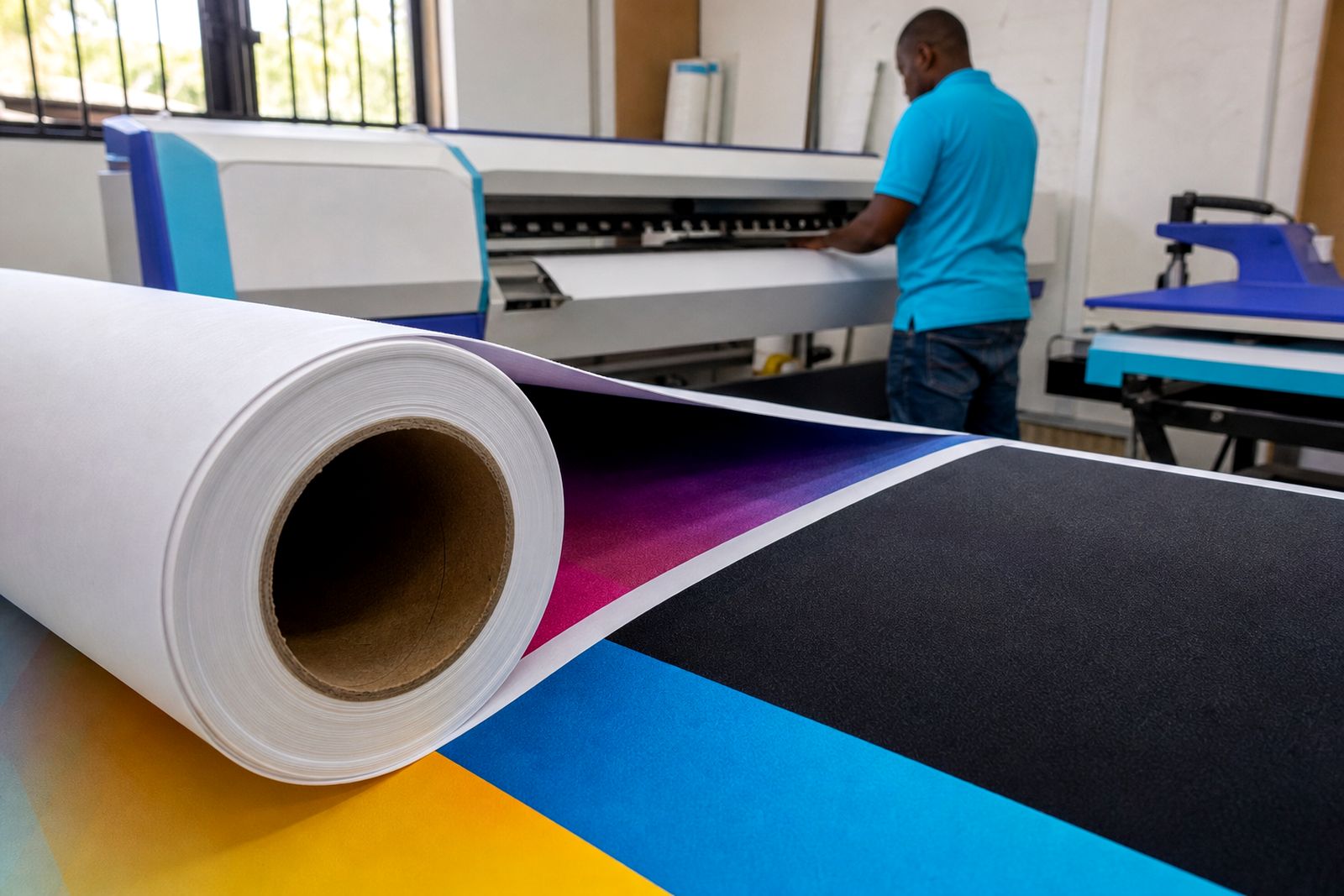
Built for dense colour and heavier laydown
This grade is used where a lighter transfer paper starts to feel marginal under heavy coverage. The 120 gsm base carries more moisture and ink before the sheet begins to soften, which helps on jobs with deep blacks, strong reds, navy panels and full background artwork. In a busy production space that can mean fewer handling issues between printing and pressing.
It is not a paper for every file. If your artwork is mostly light logos, sparse line work or short text on white goods, a lighter roll may be the better fit. Heavyweight stock earns its place when the transfer has to carry a lot of colour and still release cleanly at the press.
- Better suited to high ink loads and dark graphic areas.
- Useful where richer blacks are needed without the sheet feeling flimsy.
- More stable in handling than lighter papers during wider print runs.
- Often chosen for continuous production on fabric panels and promotional blanks.
Roll sizes and working limits
We supply this paper in wide-format roll form for production printers used in sublimation transfer work. Roll width choice depends on your printer, the width of the transfer area and how much trimming you want to do after printing. A wider roll is not always the economical answer if your artwork nests better on a narrower size.
The main working limit is drying. A 120 gsm sheet can take a generous ink load, but your print setup still needs enough heat, airflow and take-up control to let the image settle before rewinding or stacking. In coastal conditions around Durban and Pinetown, humidity can slow the drying window a bit, so operators usually allow for that in production planning.
- Choose a width that matches the printer path and your usual artwork repeat.
- Confirm core size and maximum outer roll diameter before ordering.
- Check that heater settings and paper tension can be adjusted properly.
- Allow extra drying caution on dense prints in humid weather.
Where this paper suits the job best
Heavyweight transfer paper is commonly selected for sportswear panels, fashion fabric with strong colour blocks, soft signage elements and promotional work where the image carries a lot of solid coverage. It also suits artwork with shadow detail and dark tonal areas that can look weak if the transfer base is too light for the amount of ink being laid down.
On fabric work, it can be a practical option where consistency matters across longer runs. The heavier sheet resists flutter a bit better through some printer paths, and that can help keep placement and feed more controlled. Results still depend on ink set, calendar settings and fabric coating of course, but the paper gives you more room to work on difficult files.
It is less suitable where you need very fast dry-down from light artwork at the lowest paper cost. For short-run mugs, hard substrates or lightly printed pieces, a lighter grade may make more sense than this one.
Printer and press conditions that matter
This roll is for sublimation transfer systems already set up for paper-based printing. We do not sell printers, and we do not print for the public. Before you enquire, it helps to know the print width, take-up arrangement and whether the work is going to a flat heat press or a calendar line.
For the paper to perform properly the machine needs even feed tension, clean rollers and a profile that does not flood the sheet beyond what your drying system can manage. A heavy paper can hide some weakness in handling, but it will not fix poor alignment or over-inking. If ghosting or offsetting has been a recurring issue, tell us that when you send details through our contact form so we can point you to the most suitable consumable mix.
- Wide-format sublimation printer using roll media.
- Correct tension and straight tracking across the full width.
- Adequate post-print drying before rewinding or pressing.
- Heat press or calendar settings matched to the fabric and transfer speed.
Storage, handling and day-to-day care
Keep rolls wrapped until they are needed and store them flat on a clean dry surface, away from direct sun and workshop dust. Like most coated transfer papers, this grade reacts to moisture swings. If it sits open in a damp room for too long, edge wave and feed variation can start to show, especially on wider widths.
Operators usually get the best consistency by letting the roll settle in the print room before use, then loading it with the coated side correctly oriented for the printer setup. Avoid crushing the roll ends and keep cores free from dents. A small handling mark near the edge can become a tracking nuisance later, which is frustrating on a long production day.
Protective and release papers used at the press should also be kept clean. Transfer quality is not only about the printed roll, it is also about what touches the fabric during pressing.
Details to send with your enquiry
When you ask about this product, the useful information is the part that affects transfer behaviour rather than only the roll width. Tell us what substrate you are pressing, whether the job is fabric or a coated item, and what sort of image coverage is typical. If deep blacks or saturated panels are the issue, say so plainly.
Include the printer media width, core requirement and whether you need companion protective sheets for the press. We can then match the paper more closely to the work instead of guessing from a product name alone.
- Required roll width and core size.
- Typical substrate or fabric type.
- Approximate ink coverage, light, medium or heavy.
- Press method, flat press or calendar.
- Whether you also need protective or release paper.
- Delivery town or province for courier planning.
We send across South Africa from Pinetown, including Durban, Gauteng and the Western Cape. For pricing or stock on the heavyweight 120 gsm roll, use our contact form.
What our Sublimation customers say
Verified Google reviews
Questions we get asked
Is 120 gsm better than 100 gsm for every job?
No. It is usually better on dense artwork and heavier ink laydown, but light coverage work may run well on a lighter grade at a lower consumable cost.
Can this paper help with ghosting?
It can help where sheet stability is part of the problem, but ghosting is also affected by press movement, fabric shift, moisture and release handling.
Do you sell printers or offer public printing?
No. We supply sublimation paper, protective and release papers and related consumables only.
Tell us about the job
Send sizes, materials and where you are through our contact form, and we will come back with the practical options.
Open the contact form