

Ordering and delivery
This page sets out how orders are placed, packed and sent from Pinetown to the rest of South Africa. It also covers the details that help us match the right paper to your print width, press setup and monthly usage.
How orders are placed
Orders are handled through our contact form, where you can send the paper type, size, quantity and delivery town. We sell sublimation paper rolls, sublimation paper sheets, protective tissue and release sheets for production use, but we do not print for the public and we do not sell printers.
If you already know the item you need, include the width, gsm, sheet size or roll length as well as how many cartons or rolls you want. If you are still deciding, tell us what fabric, transfer width and heat press size you are working with and we will point you to the closest fit. A short note on ink load or whether you run stretch fabric helps too, it saves a wrong paper choice on larger jobs.
- Paper type or product page reference
- Roll width, sheet size or required cut size
- Weight in gsm where relevant
- Quantity needed for current production
- Delivery suburb, town and province
- Any site limits such as receiving hours or dock access
Details worth sending before packing starts
The better the brief, the cleaner the order goes out. Rolls and sheets are not one-size-fits-all items. A fast-dry roll for everyday polyester work behaves differently from tacky paper intended to hold position on stretch fabric, and protective stock needs to match the width of the press area you are covering.
For roll orders, send the print width you run most often and whether the roll must fit a particular spindle or feed path. For sheets, note whether you need A4 or A3 and whether the work is short-run sampling or regular daily output. If you are ordering protective tissue or release sheets, mention whether they sit above the fabric, below the fabric or on both sides of the transfer stack. Small setup details matter here.
- Normal transfer size in millimetres
- Press platen size
- Fabric type, including stretch where relevant
- Expected monthly consumption
- Need for tack, fast drying or heavier paper body
- Whether the order is for stock top-up or a new application
How we pack rolls, sheets and protective stock
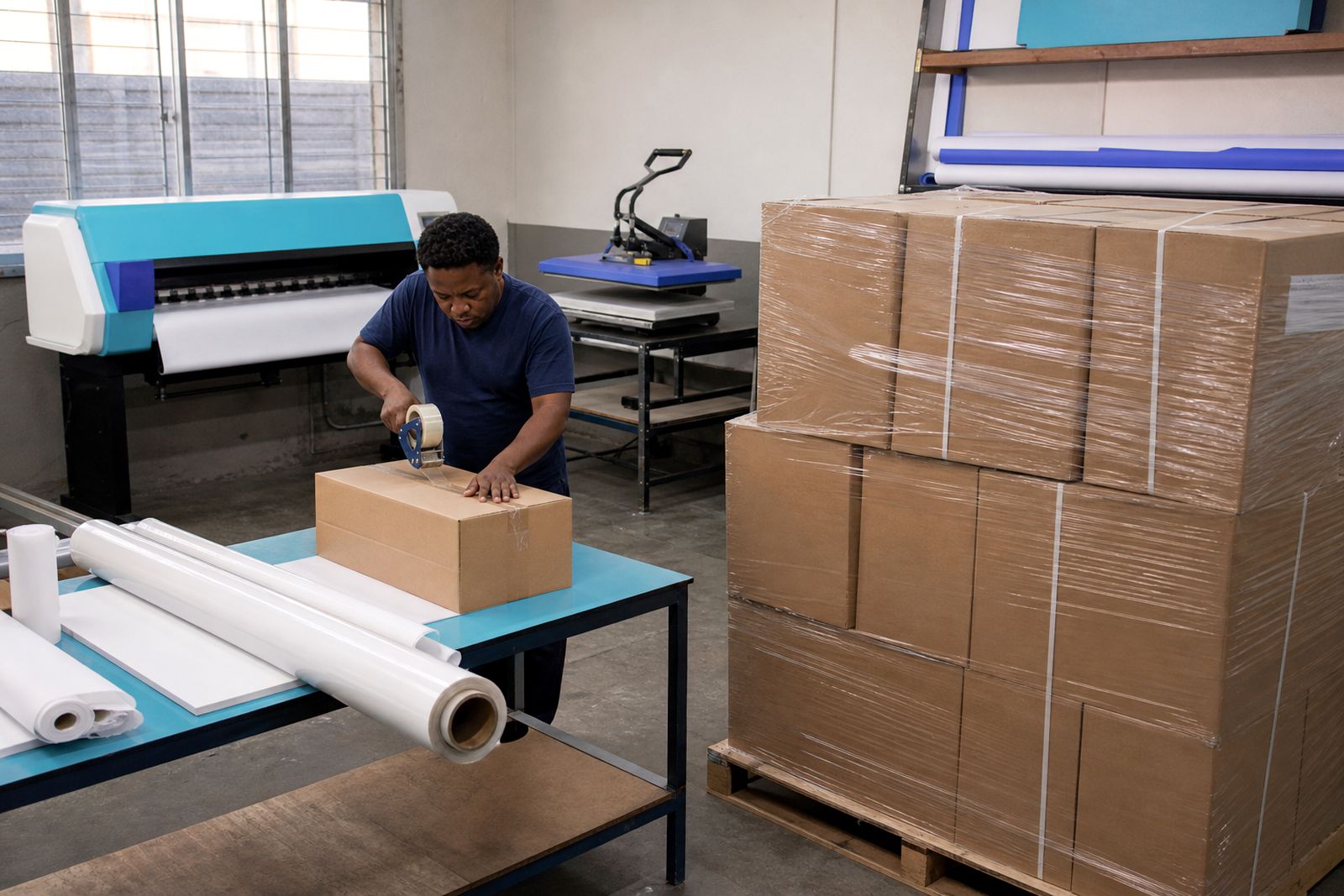
Rolls are packed to keep the edges straight and the core protected during linehaul handling. Each roll is wrapped against dust and scuffing, then secured inside a rigid outer pack suited to the length and diameter. Edge damage on transfer paper creates waste at the printer and can throw off tracking, so we pay attention to end protection rather than treating the parcel like a generic stationery box.
Sheet stock is kept flat in carton packs with inner wrapping to limit moisture pickup during transit, especially on coastal routes where humidity can creep into ordinary packaging. Protective tissue and release sheets are packed according to format, either rolled or flat-packed, depending on the item ordered and the safest courier method for that size.
Where an order includes mixed items, we separate rolls from flat sheets so that heavy cylindrical packs do not mark lighter cartons. Larger consignments may move as more than one parcel to reduce crush risk on the corners.
Courier routes and regional delivery windows
Dispatch moves out from Pinetown by courier to Durban, Gauteng, the Western Cape and every other province. Delivery timing depends mainly on route density, parcel length and whether the address is in a major metro, an outlying industrial area or a smaller inland town.
As a general guide, Durban and nearby KwaZulu-Natal points are usually the shortest leg. Gauteng and the main Western Cape centres take longer because of distance and hub sorting, while outlying provincial routes can add an extra step through a regional depot. Long rolls may travel on a different service from small cartons, so mixed orders sometimes arrive as split consignments.
- Pinetown and greater Durban: short regional leg
- Gauteng metros and industrial nodes: standard interprovincial route
- Western Cape metros: linehaul route with metro handover
- Smaller towns in any province: extra depot transfer may apply
- Remote delivery points: allow for a longer final leg
If your receiving point has restricted access, heavy-vehicle limits or a booking system, include that in the order notes. It helps prevent a parcel sitting at a depot while access is sorted out.
How pricing is worked out
Pricing is based on the product itself first, then format and quantity. Roll width, paper weight, finish type and pack size all affect the figure. Protective and release products are priced by the format supplied, whether in rolls or sheets, and larger quantities may change the rate because packing and freight can be planned more efficiently.
Courier charges are shaped by parcel dimensions as well as weight. Long rolls can cost more to move than a compact carton even when the mass is similar, because linehaul carriers rate bulky items by volumetric space. Delivery to a main metro is usually more straightforward than a remote route, and that difference shows up in the final transport charge.
When you send an order request, include exact quantities where you can. It allows us to price the paper and the freight on the actual mix rather than an estimate that needs to be corrected later.
Checks after delivery
When the order arrives, inspect the outer pack before opening and note any obvious courier damage straight away. Once opened, store paper in a dry indoor area away from direct heat and keep rolls on their cores or in their original wrap until needed. Paper that sits open in a damp room can curl or absorb moisture before it ever reaches the printer.
If you are moving to a different gsm or trying tacky stock for the first time, run a controlled test before putting the full batch into production. Check feed behaviour, drying, transfer release and any tendency to ghost on your usual press settings. A quick controlled test beats discovering an issue half way through a customer run.
For product questions after delivery, send the item details and the issue through our contact form along with the width, gsm and application. Photos of the paper edge, transfer result or packing condition are useful where damage or handling is involved.
What our Sublimation customers say
Verified Google reviews
Questions we get asked
Can I collect from Pinetown instead of using a courier?
If you need a collection arrangement, note that in your order message with the products and quantities required. We will advise on the packing format so the goods are handled properly in transit from the branch.
Do you sell printers or offer sublimation printing services?
No. We supply sublimation paper, protective sheets, release papers and related consumables only. We do not print for the public and we do not supply printers.
What should I include when asking for a price on rolls?
Send the roll type, width, gsm if known, quantity and delivery town. If you are unsure which paper to order, add your fabric type, print width and whether you need fast drying, tack or a heavier base paper.
Also worth a look
Tell us about the job
Send sizes, materials and where you are through our contact form, and we will come back with the practical options.
Open the contact form